When I moved to the northeast, people asked me, “How could you bear to live in the desert? It’s always the same.”
Long ago I visited a friend who lived in the southwest, and on the drive from the airport to his home outside town, he remarked, “You’re lucky. The desert is really green this spring.”
I laughed, assuming he was kidding. The desert was sand with dull ashy sage bushes, an occasional olive cactus, and far-off brown mountains.
I stayed to live there myself, and though it took a few years, I came to know what he meant. I began to see. Not just look, but see.
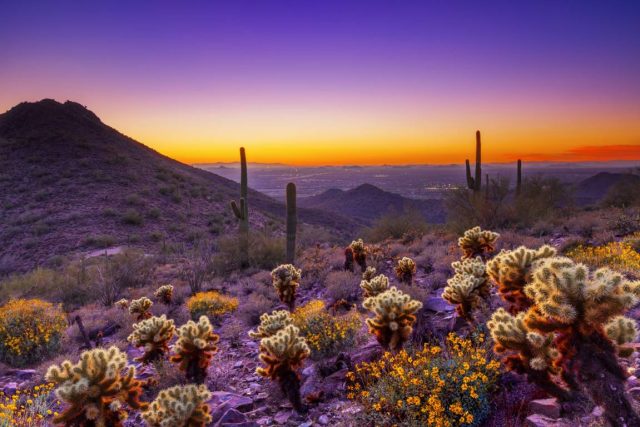
I saw how in spring Nature dips a brush in green watercolor and washes a delicate hint over the sand and the dull plants and even the brown mountains. I saw tiny yellow mariposa daisies, red poppies, desert lilies, occatillo, soft pink apache plumes that spread out low to the ground, flowing over dunes and into the arroyos where the snow-melt runs. I saw a single brilliant scarlet flower that burst out on a cactus so far from the road that you have to go out looking for it.
In summer the sun-baked sand becomes a hundred hues of ocher and orange, biscuit and Bordeaux, coffee and khaki, dun, fawn and cocoa. Even, in the shadows of the mountains, primer black.
In autumn, light takes on different slants or sinks into the sand and makes it glow from underneath. You catch a slip of amber in the corner of your eye as a creature vanishes down a hole before he’s spotted by a chocolate osprey gliding overhead on his way to the gulf.
In winter, colors are quiet but the air is so clear it hurts your eyes. Still, if you try, you can see the burnt edges of each individual mountain standing out below its crown of ethereal snow.
You can come to the north and have the season handed to you, but desert seasons must be earned.You cannot just look if you want to see; in the desert you must watch keenly for the flowers before they throw their seeds and disappear into drought. Watch cacti change from jade to gray literally day by day as you drive to work. You must throw your head back and your arms wide to measure the blue hundred-mile sky and see, far up, a bronze hawk circling with the light glinting off his wings.
I’m glad I decided to live there year-round. I learned to see how the world could change in front of me, no matter where, if only I took the time to look.
 Genie in a Box: Words and thoughts from Eugenia Parrish, Author